
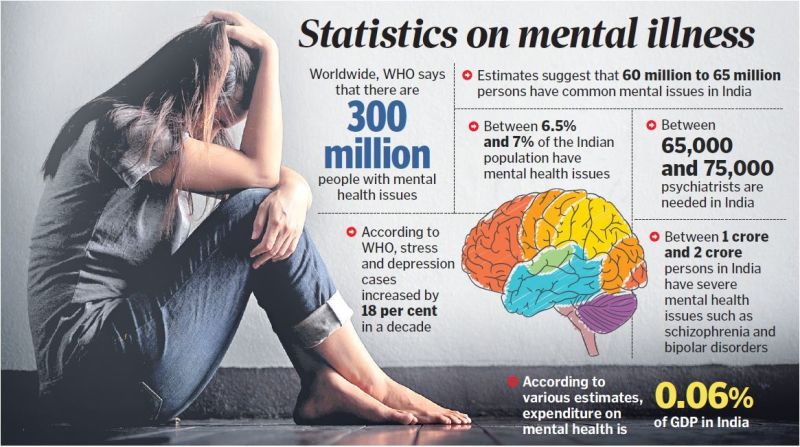
Statistics on mental illness

In India, student suicides > farmer suicides.
Read that again.
The children we’re educating are dying faster than the farmers we’ve failed.
Last week, the Supreme Court issued nine binding directions to all 60,383 higher education institutions across India.
This came after three separate benches took notice of what they called a “disturbing pattern” of student deaths.
Over 13,000 student suicides every year. For people aged 15 to 29, suicide is either the highest or second-highest cause of death. Not accidents. Not illness. Suicide.
The Court didn’t just acknowledge the crisis. It broke down what’s actually killing students: Academic pressure isn’t vague anymore.
The Court identified rigid attendance policies, badly planned curriculum, faculty shortages, and overreliance on inexperienced guest faculty as direct contributors to student distress.
Financial stress is crushing students. Scholarship payments are delayed for months (which in turn adds pressure on patients to manage their finances).
Fees are being hiked aggressively. Last year, Jamia Millia Islamia and Aligarh Muslim University (AMU) saw mass protests. Delhi University hiked fees by 17% in six months.
Here’s the part that should embarrass every institution: 28% of teaching positions across India’s central universities, IITs, NITs, IIMs, and IISERs are vacant.
Over half of those are professor-level roles. IIT Madras has 429 of 1100 positions empty. IIT Kharagpur? 822 of 1600.
Six public universities in Karnataka functioned without Vice Chancellors for over a year until late 2025.
Students are being crushed by a system running on empty.
The Court gave institutions four months to clear scholarship backlogs and fill critical vacancies. It also called out colleges for “individualizing” student suicides instead of taking institutional responsibility.
In 2017, S. Anitha scored 1176 out of 1200 in her state board exams. She fought NEET in the Supreme Court.
When the Court upheld the exam, her lawyer reportedly said “any further appeal can only be done to God.” A month later, 17-year-old Anitha died by suicide
The Court later acknowledged that life has become “a series of tests” for students and that competitive exams subject them to “relentless psychological pressure.”
Will institutions actually comply, or will this become another set of ignored guidelines?
Are we building an education system or a pressure cooker with a 13,000-student annual casualty rate?